



New Home Smell and VOCs: How to Clear the Air (NZ Guide)

That fresh smell in a new build, a renovated room, or a flat-pack wardrobe you just put together is not really a "clean" smell. It is off-gassing: a mix of gases called volatile organic compounds (VOCs) escaping from paint, adhesives, flooring and new furnishings. For some people it is just a passing smell. For others it brings headaches, a scratchy throat, or stinging eyes until it clears.
The good news is that off-gassing fades over time, and there are practical ways to speed it up. The honest part is that no single tool fixes it on its own. The best results come from layering a few simple things: ventilation, a bit of patience, and a purifier with enough carbon to help where airing out falls short.
This guide is about new-home and renovation smells specifically. If you are chasing everyday smells like cooking, pets or smoke, our guide to air purifiers and odours is the better read.
This article explains:
- What VOCs are and where the new-home smell comes from
- How long off-gassing usually lasts
- Why ventilation comes first, and how to do it well in a NZ home
- What a formaldehyde cookout is, and when it helps
- Where an air purifier with carbon fits in, and where it does not
Quick Summary: New Home Smell and VOCs
That new-home smell is off-gassing: VOCs like formaldehyde, benzene and toluene leaving new materials
It is worst in the first days and weeks, then fades over months. Some materials off-gas at low levels for a year or more
Ventilation is the most effective fix. Fresh air dilutes and removes VOCs faster than anything else
A formaldehyde cookout can force off-gassing to happen faster, so you clear it sooner
An air purifier with real activated carbon helps reduce VOCs, especially when you cannot ventilate, but it works best as one layer, not a standalone fix
Carbon weight and airflow both matter. A thin carbon mesh saturates fast and does very little
Table of contents
1. What's actually behind that new-home smell
VOCs are gases released from certain solids and liquids at normal room temperature. New builds, renovations and new furnishings are full of materials that give them off. The common ones include:
- Formaldehyde: the big one. Comes from the glues in engineered wood like MDF, particleboard and plywood, plus some adhesives, insulation and fabrics. It has a sharp, slightly pickle-like smell and is the VOC most worth paying attention to.
- Benzene and toluene: found in paints, varnishes, glues and solvents.
- Other VOCs: from flooring, carpet backing, foam in new mattresses and sofas, sealants and finishes.
Newly built homes can carry noticeably higher VOC levels than older ones while everything is fresh, simply because there is so much new material in one place releasing gas at once. Different materials behave differently too. Paint and solvents flash off quickly. Pressed-wood furniture and laminate flooring release slowly and steadily for much longer.

A note on measuring VOCs. A home TVOC monitor can be a useful way to track whether levels are trending down over time, or to see how much difference ventilation is making. Just keep in mind it reads total VOCs rather than any one chemical, so treat it as a general guide rather than a precise reading. We do not currently stock air quality monitors, so this guide stays focused on what you can do about VOCs: ventilate, give it time, and use carbon for the background.
2. How long does off-gassing actually last?
There is no single answer, because it depends on the materials, the temperature, the humidity and how well the space is ventilated. As a rough guide:
| Source | When most off-gassing happens |
|---|---|
| Paint and solvents | Heaviest for the first few days, easing over a few weeks |
| New carpet | Strongest in the first week, most of it gone within a month or two |
| Flooring (laminate, vinyl, engineered) | Tapers over the first few months |
| New mattresses and upholstered furniture | Most intense in the first weeks, can linger for months |
| Pressed-wood furniture and cabinetry (MDF, particleboard) | The slow burner. Can release formaldehyde at low levels for a year or more |
The pattern is the same across the board: worst at the start, then a steep drop, then a long slow tail. For formaldehyde specifically, the best real-world data suggests it can take around two years for a new or renovated home to settle back to the levels of an established home, though warmth and good airflow speed that up a lot.
Off-gassing is worst at the start, drops quickly over the first few months, then trails off slowly. Most of the smell is gone long before the last of the VOCs are.
The New Zealand angle worth knowing: Newer Kiwi homes are built tighter than older ones, with better insulation and fewer draughts. That is great for warmth and power bills, but it also means a new build holds onto VOCs and moisture more than a draughty old villa would. In winter, when nobody wants to open a window, those gases have even less chance to escape. That makes deliberate ventilation more important in a modern home, not less.
3. Ventilation comes first
If you do one thing about new-home VOCs, make it ventilation. Bringing in outdoor air dilutes and removes VOCs faster and more completely than any gadget, because it physically replaces the polluted air rather than treating it.
Natural ventilation: open windows and doors, ideally on opposite sides of the room or house, to get a cross breeze going. Even 10 to 15 minutes of a good through-draught makes a real difference. Do it daily while things are fresh.
Mechanical ventilation: if you have a home ventilation system (HRV, DVS or similar), use it. Run rangehoods and bathroom extractor fans, especially during and after any work like painting.
Air things out before they come inside: unbox new furniture, mattresses and rugs in the garage or outside, and let them breathe for a few days before they go in the room if you can. A warm, sunny spot helps.
The reality in New Zealand is that winter makes all of this harder. Nobody wants to lose hard-won warmth to an open window. The practical compromise is short, sharp bursts of ventilation, rather than leaving a window cracked all day. You clear a lot of the air without chilling the whole house.
4. Formaldehyde cookouts: forcing it out faster

A formaldehyde cookout (sometimes called a bake-out) speeds up off-gassing on purpose, so you get the worst of it over with sooner. Heat makes materials release formaldehyde and other VOCs faster, so the idea is to heat the space up, let it off-gas hard, then flush it all out.
Smart Air has a detailed guide here, but the basic process is:
- Close the windows and doors and warm the space up, with heating or natural sun. Aim for 30°C or more if you can.
- Hold that temperature for several hours, ideally 6 to 8.
- Come back, open everything up and ventilate hard to clear the released VOCs and bring the temperature back to normal.
- Repeat the cycle several times over following days.
Two important caveats. Stay out of the room while the cookout is running, since you are deliberately driving VOC levels up. And treat it as a head start, not a cure. A cookout brings forward off-gassing that would have happened anyway. It does not pull every last bit out of the materials, and the slow-releasing sources will keep trickling for a while afterward.
A cookout brings off-gassing forward so you get it over with sooner. It is a head start, not a finish line.
5. Where an air purifier fits in
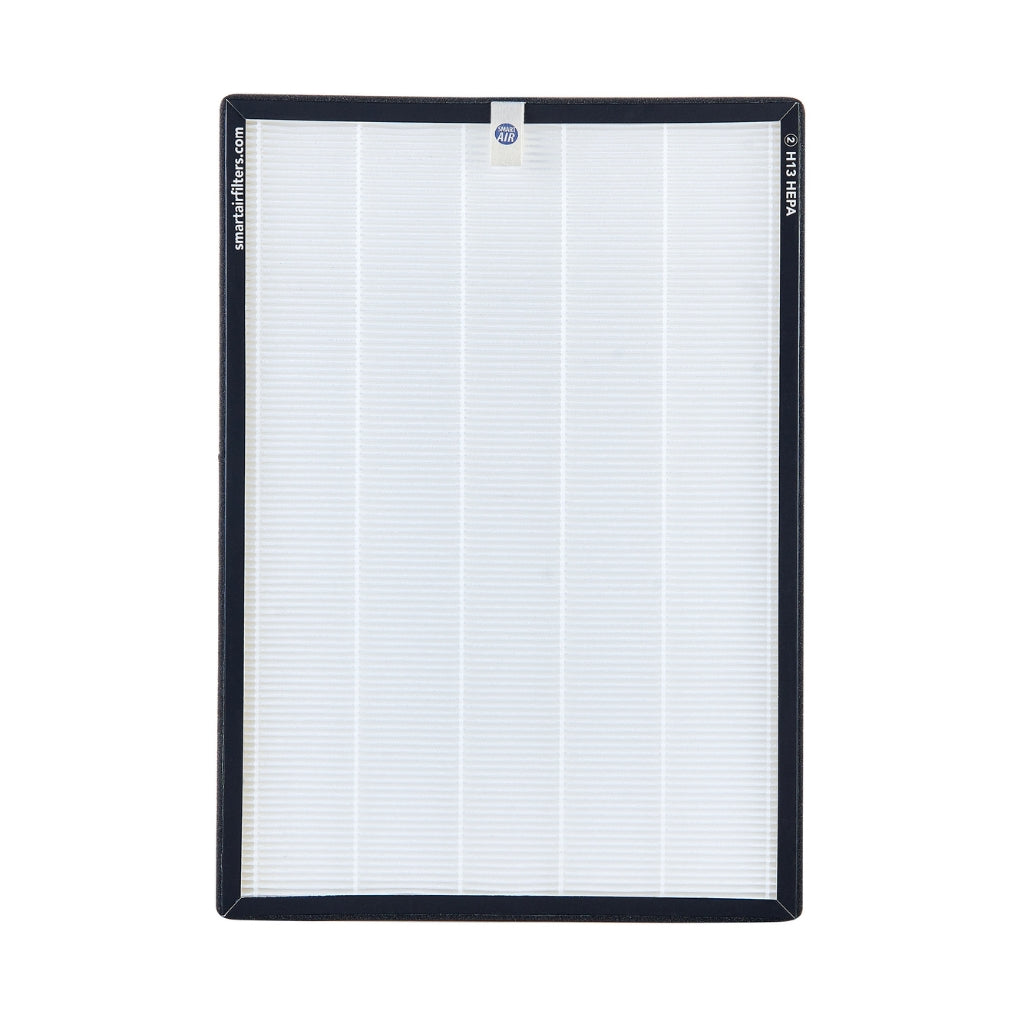
Here is the part to be clear about, because it is widely misunderstood. A HEPA filter, the part that does the heavy lifting in most air purifiers, captures particles like dust, pollen and smoke. VOCs are gases, and gases pass straight through HEPA. So HEPA on its own does nothing for the new-home smell.
To reduce VOCs you need activated carbon. Carbon works by adsorption: gas molecules stick to the huge internal surface area of the carbon as air passes through. Three things decide how well it works:
Carbon form: real carbon pellets or granules, not a thin carbon-coated mesh. A flimsy mesh layer might take the edge off a smell for a week, then it is saturated and doing nothing.
Carbon weight: more carbon means more surface area and longer-lasting VOC reduction. This is why we talk about carbon in grams and kilograms.
Airflow: the purifier has to move enough air to actually pull room air through the carbon. Plenty of carbon with weak airflow still leaves most of the room untreated.
Now the honest limitations, because they matter here more than in most articles:
- Carbon reduces VOCs, it does not eliminate them. It lowers background levels and takes the edge off, but it will not zero out a freshly painted room.
- The lightest, most volatile gases, and formaldehyde is the classic example, are the hardest for standard carbon to hold onto. It still helps (Smart Air's own testing showed activated carbon cutting formaldehyde noticeably faster than airflow alone), but do not expect it to fully scrub a high-formaldehyde space.
So, the right mental model is layering. Ventilation does the bulk of the work. A cookout brings the worst forward. Low-VOC product choices reduce the source. And a purifier with serious carbon handles the day-to-day background, especially overnight or in winter when you cannot have the windows open. It is the layer that keeps working when ventilation stops.
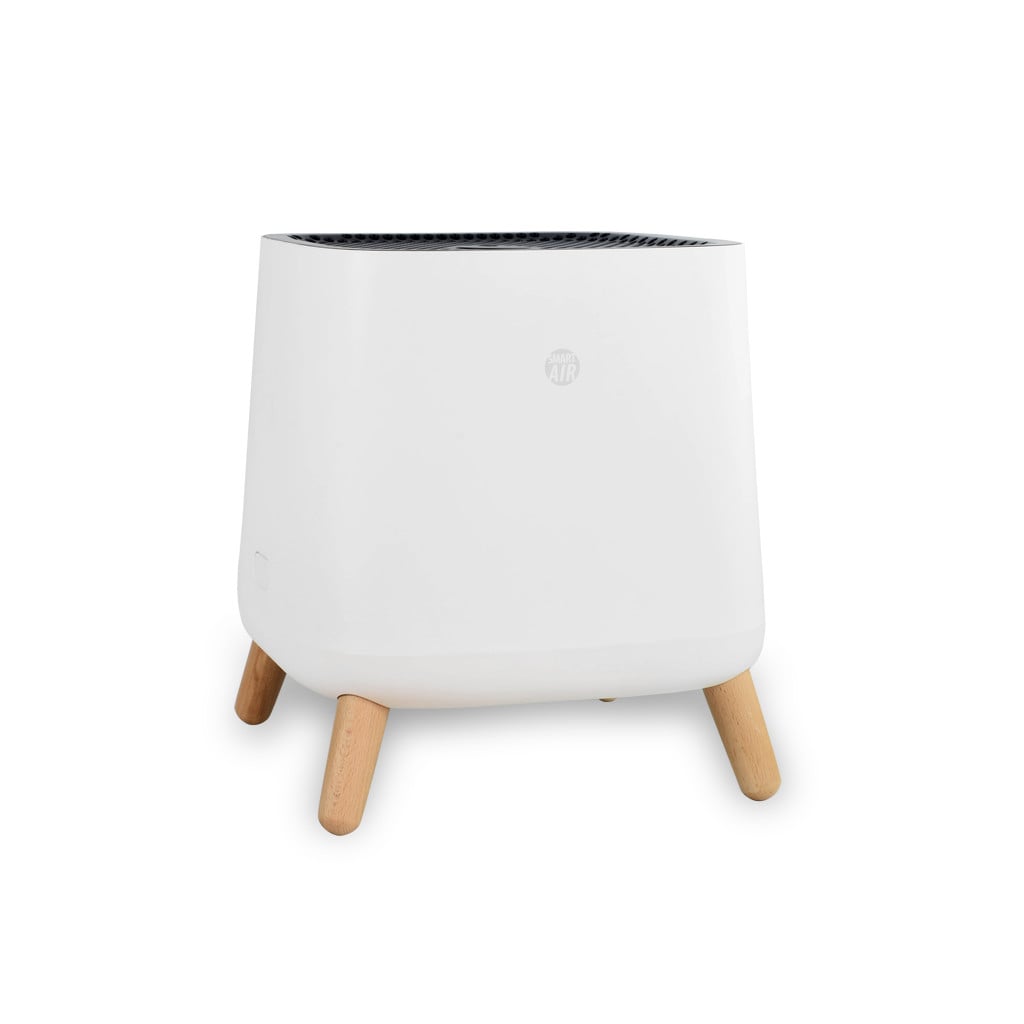
The SA700 with carbon: our strongest VOC and odour setup
Key features:
- 1.5kg of activated carbon with the optional twin carbon filters fitted (750g per side), the most of any purifier we sell
- 720 m³/h CADR, so it keeps cycling the whole room's air through that carbon rather than treating a small zone
- Runs at a quiet 42dB and just 12 watts, so you can leave it going 24/7 (around $2.20 a month) while a new home settles
- HEPA and carbon kept separate, so you replace the carbon on its own when it saturates, which it will faster in a high-VOC space
- Floor, wall or ceiling mountable, handy in a new build where floor space is still being sorted
- Carbon is an optional add-on, not included as standard, so add it if VOCs and odours are your main concern

6. How much carbon each Smart Air purifier holds
If VOCs are your priority, carbon quantity is the spec to look at. Here is how the range compares, from least to most carbon. Remember that on the Sqair and SA600 the carbon is included as standard, while on the Blast Mini, Blast and SA700 it is an optional add-on you will want to factor in for any VOC use case.
| Purifier | Total activated carbon | Carbon included? | Best suited to |
|---|---|---|---|
| Sqair | 140g (1 filter) | Included | Bedrooms and small rooms, lighter VOC loads |
| SA600 | 340g (2 x 170g) | Included | Larger bedrooms and living spaces, everyday VOCs |
| Blast Mini Mk II | 550g | Optional add-on | Big open-plan spaces |
| Blast Mk II | ~900g | Optional add-on | Very large spaces |
| SA700 | 1.5kg (2 x 750g) | Optional add-on | The most demanding VOC and off-gassing jobs |
One handy extra on the smaller units: both the Sqair and SA600 can run extra carbon in place of HEPA for a smell-dominated, particle-light situation. The SA600 can swap its two HEPA filters for two more carbon filters, and the Sqair can take around five carbon filters in total. It is niche, but a real option if odour is the whole problem.
For when to actually swap a carbon filter, there is no colour change to watch like there is with HEPA. The guide is the smell test: while it is still keeping odours down it is working, and once smells it used to handle start getting through, it is saturated. Our filter replacement guide covers this in more detail.
7. A realistic plan for a new home or reno
Putting it together, here is a sensible order of attack:
- Choose lower-VOC materials where you still can. Look for low-VOC or formaldehyde-free labels on paint, flooring and furniture. Solid timber off-gasses far less than MDF or particleboard.
- Ventilate hard and often, especially in the first weeks. Cross-breezes, rangehoods, extractor fans, and airing new items out before they come inside.
- Run a cookout or two if the smell is strong and you want to fast-track the worst of it.
- Add a carbon purifier for the background load, overnight and through winter when the windows stay shut. This is where the SA700 with carbon earns its place.
- Give it time. Most of the smell clears in the first few months. The slow sources fade after that.
No one of these solves it alone. Together they get you to clean, settled air a lot faster than waiting it out would.
Wrapping up: Can you really clear the new-home smell?
Yes, mostly, and faster than you might think, as long as you treat it as a layered job rather than looking for a single fix.
- That new-home smell is off-gassing: VOCs like formaldehyde leaving fresh materials
- It is worst in the first days and weeks, then fades over months, with slow sources trailing for a year or more
- Ventilation removes VOCs faster than anything else, so it comes first
- A formaldehyde cookout can bring the worst of the off-gassing forward
- An air purifier with real carbon handles the background, especially when you cannot ventilate
- Carbon weight and airflow both matter, and even the best carbon reduces rather than eliminates VOCs
Carbon-equipped HEPA purifiers for new homes and renos
These purifiers pair HEPA filtration for particles with real activated carbon for VOCs and odours. For new-build and renovation off-gassing, more carbon and stronger airflow do more work, which is why the SA700 leads here.
Is the new-home smell actually harmful?
For most people it is mainly an irritant: headaches, dizziness, or eye, nose and throat irritation while levels are high. Sensitive people, young children and anyone with asthma or allergies tend to feel it more. Reducing the levels and airing the space out is the sensible response.
How long until the smell goes away?
The strong smell usually fades within the first few weeks to a couple of months. Lower-level off-gassing from pressed-wood furniture and some flooring can continue for a year or more, though you often will not notice it.
Will an air purifier remove the new-home smell completely?
No, and any product that claims to is overselling. A purifier with good carbon reduces VOCs and helps the room feel fresher, but ventilation and time do most of the work. Think of the purifier as one layer, not the whole answer.
Why does carbon weight matter so much?
More carbon means more surface area to hold gases, and a longer working life before it saturates. A thin carbon-coated mesh can stop helping within weeks, while a purifier with hundreds of grams or more of real carbon keeps going far longer.
Do I still need to ventilate if I have a carbon purifier?
Yes. Ventilation physically removes VOCs from the home, while a purifier treats the air already inside. They do different jobs, and ventilation should stay your first line.
How do I know when the carbon filter needs replacing?
There is no colour change like there is with HEPA. Use the smell test: when smells the carbon used to handle start getting through again, it is saturated and ready to swap. New homes will use carbon up faster than a settled home.