



The Best Air Purifiers in New Zealand | 2026 Comparison

This is our fourth year running this nationwide comparison, now updated for 2026. Over that time, we’ve seen plenty of air purifiers come and go - often from brands where air quality isn’t their main focus. Some even vanish entirely, leaving users without replacement filters.
That’s why we refresh this guide each year: to show which models are properly supported in New Zealand, how they actually perform, and which ones deliver the best value for clean air.
Table of contents
1. How We Compare Purifiers
We focus on the two figures that matter most: Clean Air Delivery Rate (CADR) and noise (dB).
💨CADR measures how much clean air a purifier produces each hour. The higher the number, the faster it cleans and the larger the space it can handle. We use this figure because manufacturer recommended room sizes are often inaccurate.
🎶Noise tells you how comfortable it is to live with. We use maximum noise levels for fair comparison, rather than the quiet “sleep-mode” numbers that hide reduced airflow.
As a guide:
- <50 dB - relatively quiet for daytime use, fine in living areas but still very noticeable at night
- 50–54 dB - modest background noise, upper limit for comfortable indoor environments
- 55–59 dB - similar to normal conversation, very noticeable if close by
- 60+ dB - loud and disruptive, best avoided for long periods

Together, these two metrics give the clearest picture of real-world performance: how quickly a purifier cleans the air and how comfortably it does it.
2. Comparison Analysis (2026)
Our latest update shows the same pattern as previous years, only more clearly: price does not always equal performance.
Two figures make the point. Of the 59 models we compared, only 14 stay under 50 dB at full output. And of those 14, the three highest CADR figures all belong to Smart Air. Plenty of purifiers are quiet, but most of them are quiet because they are barely moving any air.
The other pattern worth knowing about is ionisers. In the under $350 bracket, seven of the 13 non-Smart Air models include an ioniser or plasma function. These can lift a published CADR figure without removing anything from the room, which is worth understanding before you compare numbers.
Let’s start with the best air purifiers under $350 - where quiet, efficient performance matters.
3. Budget Air Purifiers Under $350 (for smaller spaces, up to ~40m²)
This category is aimed at bedrooms, nurseries, and smaller living areas or apartments. It is for people who want quiet, effective air cleaning without spending a fortune.
We assessed 14 models from brands including Blueair, Winix, Sunbeam, Breville, Trusens, Breathing Better, Fellowes and Sheffield.
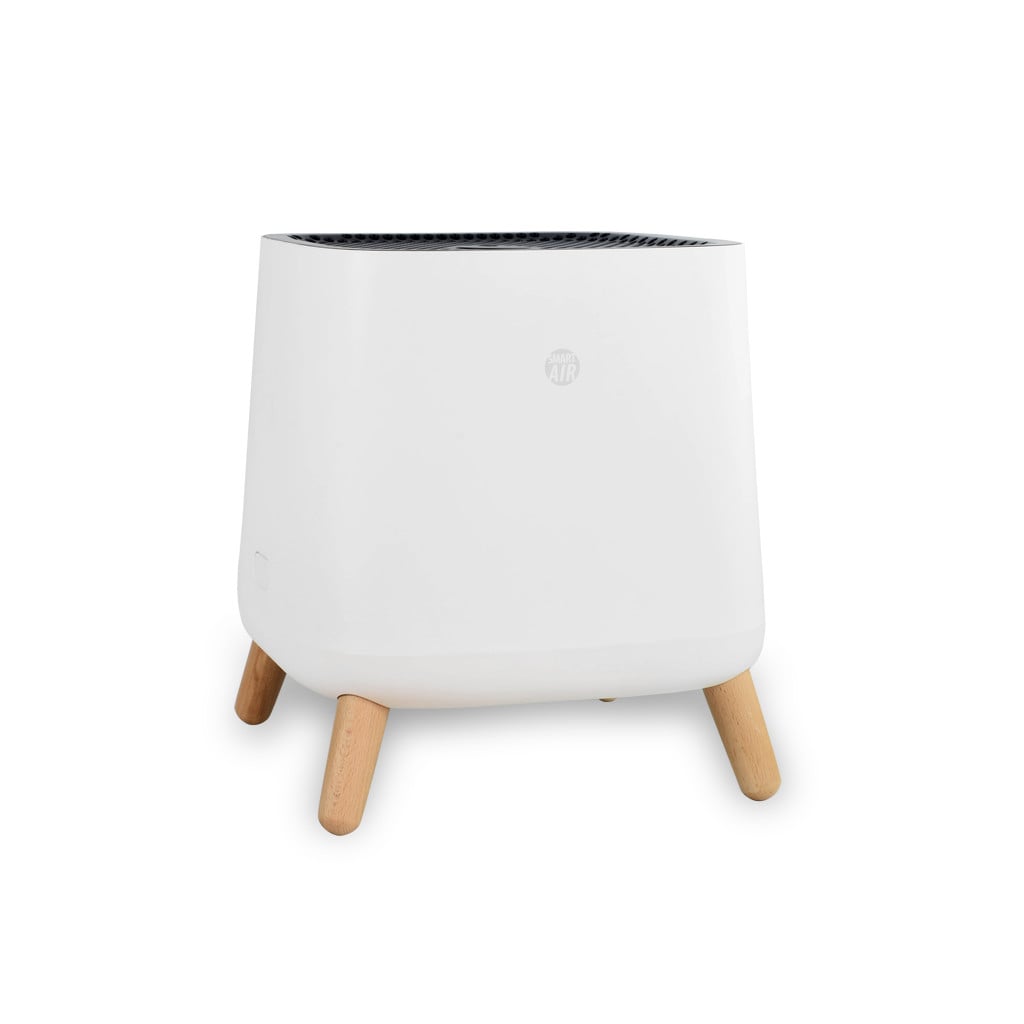
🏆 Best Overall: Smart Air Sqair
📊 Key Stats:
- CADR: 315 m³/h (>50% higher than competitors)
- Noise: 23 to 52 dB, with 23 dB on low
- Room coverage: Cleans a 43 m² room in about 20 minutes
- Price: $329.99 (HEPA only version) or $349.99 with carbon filter added

👍 Why we like it:
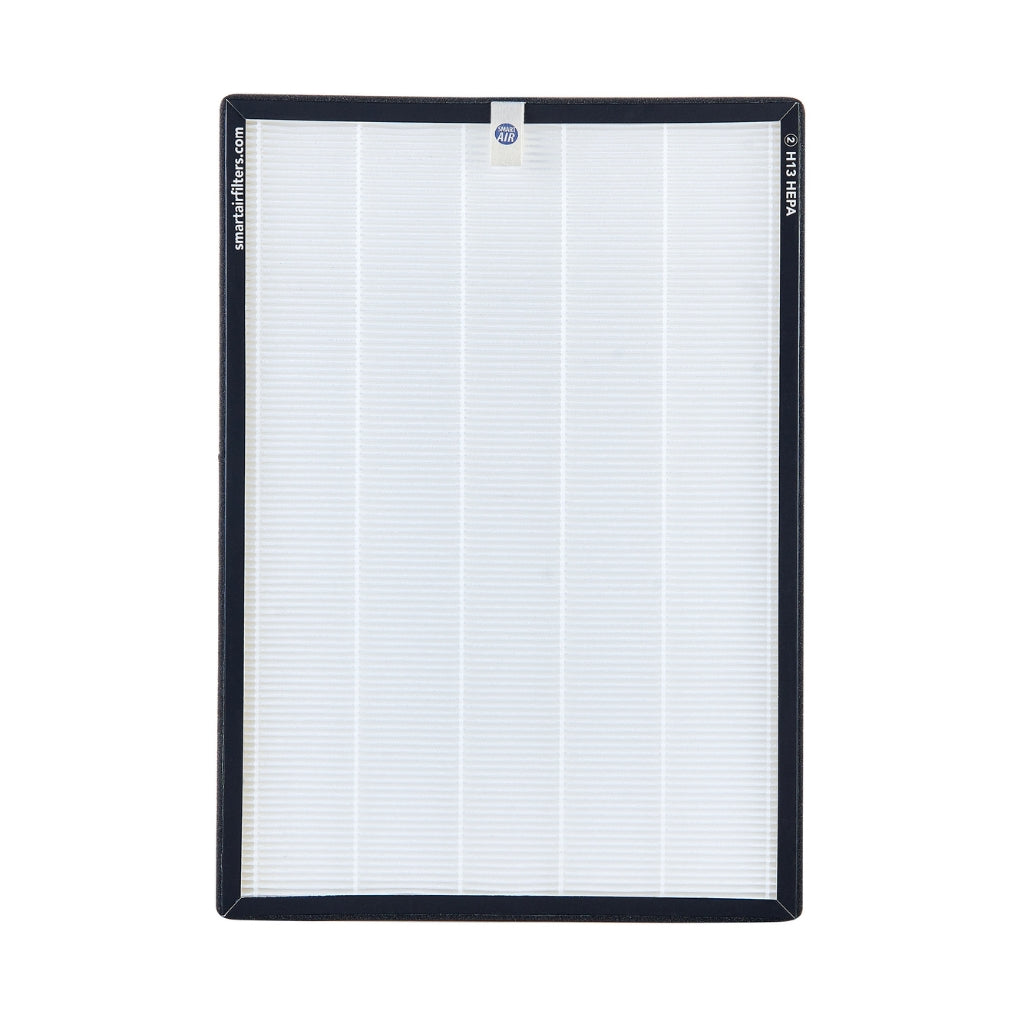
The Sqair delivers the most clean air under $350 in New Zealand, around 25% more than the next best. Its H12 HEPA filter has a large 1.5 m² surface area (around 22 A4 pages), giving excellent capture for smoke, dust, pollen and pet dander.
It also gives you room to run it quietly. At 23 dB on low it's quieter than many other models, so you can leave it going overnight and step it up when you need to.
Because it relies purely on proven HEPA + Carbon filtration (no ionisers, no ozone), it's a safe, science-based choice for households with respiratory concerns or young children. The HEPA-only version at $329.99 covers particles if odours aren't a concern.
🔍 How It Compares
| Brand | Model | Max CADR | Max Noise | Price |
| Smart Air | The Sqair | 315m³/hr | 52dB | $329.99 |
| Winix* | Compact 4 Stage* | 250m³/hr* | 52dB | $248.00 |
| Blueair* | Max 3250i Medium* | 239m³/hr* | 46dB | $349.00 |
| Sunbeam* | Fresh Protect* | 193m³/hr* | 59dB | $248.00 |
| Sheffield* | 4 Stage Compact* | 120m³/hr* | 50dB | $99.99 |
| Fellowes* | AeraMax DX5* | 58m³/hr* | 70dB | $345.00 |
*On those asterisks: independent testing of a Blueair unit found CADR dropped by 19% to 53% (depending on particle type) once the ioniser was switched off. Manufacturers rarely publish that number, so ioniser-assisted figures aren't directly comparable. More on how ionisers inflate CADR.
Graph 1: Air purifiers under $350 in NZ (price vs max noise vs CADR).

4. Air Purifiers $350 to $500 in New Zealand (for medium spaces, up to ~60m²)
This range suits medium-sized living rooms, apartments and shared spaces where you want strong air cleaning without excess noise.
We compared 12 models from brands including Daikin, Shark, Winix, Breville, Xiaomi, Sharp, Arlec and Trusens.
🏆 Best Overall: Smart Air SA600
📊 Key Stats:
- CADR: 508 m³/h, equal to the highest in this bracket
- Noise: 16 – 51dB (quietest in class)
- Room coverage: Cleans a 60 m² room in just 18 minutes
- Price: $489.99

👍 Why we like it:
The SA600 packs big-room performance into a compact cabinet. Its dual-inlet design and twin H13 HEPA + carbon filters give it the highest clean air output in this bracket, with no ioniser inflating the number.
The figure worth focusing on is speed 4: 320 m³/h at just 41 dB. That's more clean air than seven of the other eleven models here produce flat out, and quieter than all of them bar the Daikin. Speed 5 is there for a fast clean, and Speed 1 drops to 16 dB overnight.
Add its "Do Not Disturb" mode to avoid lights and a child lock, and you get a purifier that works as well in the bedroom as the living area or office.
🔍 How It Compares
| Brand | Model | Max CADR | Max Noise | Price |
| Smart Air | SA600 | 508m³/hr | 51dB | $489.99 |
| Xiaomi* | Pro 4 Smart Air* | 500m³/hr* | 64dB | $400.00 |
| Winix* | Zero 4 Stage* | 390m³/hr* | 47dB | $479.00 |
| Shark | NeverChange 5 Max | 347m³/hr | 55dB | $450.00 |
| Daikin* | MC30YPVM* |
180m³/hr* | 37dB | $488.75 |
* This purifier includes an ioniser/plasma function which may inflate CADR figures.
Graph 2: Air Purifiers $350- $500 in NZ (Price vs max noise vs CADR).

5. Air Purifiers for larger spaces under $1000 in New Zealand (Up to ~85m²)
When you are dealing with large living areas, classrooms, clinics or open-plan apartments, you need serious airflow without the jet engine noise.
We assessed 15 models from brands including Sharp, Daikin, Oransi, Winix, Breville, Trusens and Dyson. Performance varied more here than in any other bracket. Some units genuinely clean a whole room, others struggle despite premium pricing.
This is also the one bracket where we have two picks rather than one, because they are the two highest CADR figures on the list and they answer slightly different questions.
🏆 Best for constant, low-cost running: Smart Air SA700
📊 Key Stats:
- CADR: 720 m³/h
- Noise: 42 dB, single speed
- Power: 12 W
- Room coverage: Cleans a 78 m² space in 16mins
- Price: $799.99

👍 Why we like it:
New this year, a manufactured take on the Corsi-Rosenthal box: a flat HEPA panel driven by nine PC-grade fans in an aluminium housing. One speed, always full, and that's the point. 42 dB at full output is quieter than most purifiers on their middle setting, and at 12 W it costs about 7 cents a day running 24/7.
It ships with E11 filters, with an H14 set sold separately for maximum capture (490 m³/h, certified to EN1822. It also wall or ceiling mounts, which makes it our first pick for clinics and classrooms.
🏆 Best for flexible, whisper-quiet power: Smart Air Blast Mini Mk II
📊 Key Stats:
- CADR: 740 m³/h, the highest in this bracket
- Noise: 36 to 49 dB across three speeds
- Power: 49 to 122 W
- Room coverage: up to 85 m², cleaned in about 17 minutes
- Price: $899.99

👍 Why we like it:
The flexible option. H13 HEPA as standard, a washable pre-filter, and three speeds, so you can match output to the room without losing performance. Even on its quietest setting, 36 dB, it still delivers 340 m³/h, more than plenty of purifiers manage flat out.
It sits on castors, so it moves between rooms easily but does take up floor space.
🔍 How It Compares
| Brand | Model | Max CADR | Max Noise | Price |
| Smart Air | Blast Mini Mk II | 740m³/hr | 49dB | $899.99 |
| Smart Air | SA700 | 720m³/hr | 42dB | $799.99 |
| Oransi | Mod Hepa | 574m³/hr | 49dB | $985.00 |
| Breville | Smart Air Viral Protect Max | 530m³/hr | 54dB | $700.00 |
| Winix* | Zero + Pro 5 Stage* | 470m³/hr* | 50dB | $750.00 |
| Dyson | Pure Hot+Cool HP03 | 113m³/hr | 62dB | $899.00 |
Graph 3: Air purifiers $500 - $999 in New Zealand (price vs max noise vs CADR).

6. Large & Commercial Air Purifiers over $1000 in New Zealand (Up to ~130m²)
This category covers large homes, gyms, clinics, classrooms and shared spaces, anywhere serious clean air output is needed.
We compared 18 models from brands including IQAir, Trusens, Dyson, Breathing Better, Fellowes, Daikin and I-Air. Prices range from just over $1000 to nearly $13,000, and as in every other bracket, price does not reliably predict performance or quietness.
🏆 Best Overall: Smart Air Blast Mk II
📊 Key Stats:
- CADR: 950 m³/h, highest in New Zealand
- Room coverage: Cleans 130 m² in 21 minutes
- Noise: Just 43 dB, the quietest large unit around
- Price: $1,249.99

👍 Why we like it:
The Blast Mk II delivers commercial-scale output in a package that stays comfortable to sit next to. At 950 m³/h it out-performs purifiers costing three or four times as much.
It's also the only unit over $1000 in this comparison that stays under 50 dB at full output. Everything else in the bracket sits between 55 and 70 dB when it's working hard.
It's built on the same principle as the rest of the range: large HEPA surface area, high airflow, and zero gimmicks. With H13 HEPA and optional carbon filtration, it suits schools, clinics, fitness studios and large open-plan homes.
🔍 How It Compares
| Brand | Model | Max CADR | Max Noise | Price |
| Smart Air | Blast Mk II | 950m³/hr | 43dB | $1249.99 |
| Trusens | Z6000 | 880m³/hr | 63dB | $2095.00 |
| IQAir | CleanZone SL | 820m³/hr | 56dB | $11,500 |
| Breathing Better* | X-Large Room Purifier* | 800m³/hr* | 70dB | $1499.00 |
| Fellowes* | AeraMax Pro AM4* | 748m³/hr* | 68dB | $2300.00 |
| Dyson | Purifier Hot + Cool | 311m³/hr | 62dB | $1099 |
* This purifier includes an ioniser/plasma function which may inflate CADR figures.
The Smart Air Blast Mk II is the only model here that pairs high airflow with a noise level you can hold a conversation over.
The Trusens Z6000 comes closest on output but runs 20 dB louder and costs $845 more. IQAir builds genuinely serious equipment with specialised carbon options, but the CleanZone SL is over nine times the price for 14% less airflow.
At the other end, Dyson's premium Hot + Cool series delivers about a third of the airflow at 62 dB, which is a reminder that sleek design and clean air are not the same purchase.
Graph 4: Air Purifiers $1000+ in New Zealand (price vs max noise vs CADR).

Two models are left off this chart to keep the rest readable: the IQAir CleanZone SL ($11,500) and the I-Air Pro Air Healer ($12,883). Both are in the full dataset and the CleanZone SL is in the table above.
7. Summary: What We Learned From the Comparisons
After going through nearly every purifier on sale in New Zealand, the same trend holds: the best performing units are not the most expensive ones.
Two numbers from this year's data make the point:
- Only 14 of the 59 models stay under 50 dB at full output. Most quiet purifiers are quiet because they move very little air.
- Of those 14, the three highest CADR figures are all Smart Air. The next best is the Oransi Mod HEPA at 574 m³/h.
Across every bracket, CADR and noise tell the real story. Some premium models look sleek and move very little air, while a few specialist brands deliver far more performance for the money.
The purifiers that consistently stand out combine:
High CADR – lots of clean air, fast
Low noise – quiet enough for daily use
Reliable filter support – parts readily available in NZ
8. How We Source and Verify the Data
We’ve made every effort to ensure the numbers here are accurate and up to date, but air purifier data can be patchy. Some brands don’t publish CADR or noise levels at all (we’re looking at you Dyson and Shark), or publish only partial figures.
We started with over 80 models available in New Zealand this year and included the 59 we could verify on both CADR and noise. Here is the approach:
- Manufacturer or retailer specs - when CADR and noise levels are published clearly.
- EnergyStar database - where CADR is independently verified.
- Independent tester reviews (e.g. Housefresh, Rtings) when official data isn’t available.
- If no reliable CADR data can be found, we exclude the model.
That’s why this guide shows every purifier in NZ with verifiable performance data. While we’ve double-checked everything, there may still be small differences between sources.
9. Why Can You Trust This guide?
The internet is full of “Top 10 Air Purifiers” and “Best Purifiers for Dust” lists - even from well-known outlets. Unfortunately, many are built to generate commission, not to give you the best advice.
We want to be upfront: yes, we are selling some of the purifiers in this guide. But unlike affiliate-driven lists, our business depends on you being satisfied years down the track. That means filters being available, performance matching the claims, and you getting genuine value.
That's why we aren't just telling you which are the best, we're showing you the data so you can make an informed decision.
10. Why you can’t trust every “Best Of” list
To show what we mean: in 2024, the NZ Herald published their “Best Air Purifiers in New Zealand” picks. The problems? Many. It was clear this was written by someone (or AI) with no knowledge of air purifiers.
They included models with poor clean air performance, no filters available and unsupported models drop shipped from overseas. Their reason for publishing isn’t to inform you, it’s to earn commission on the products they list.
We broke this down in detail here:

It's a good reminder that while these lists look authoritative, they don't hold up when you check the numbers.
Our aim is different: to compare all models where data exists, show how they stack up, and make it transparent why certain units come out ahead.
11. Features That Don't Add Real Value
When shopping around you’ll see lots of air purifiers with added bells and whistles. Some of these aren’t just unnecessary, they can be unhelpful or even harmful:
Ionisers / Negative ion generators - can create ozone and just push particles onto surfaces instead of removing them. These are used to improve CADR figures, without filtering out particulates.
UV lights - sound impressive, but don’t get enough contact time to work in fast-moving air. HEPA filters already capture these particles.
Auto sensors - often cheap, inaccurate and misleading. We recommend a separate, accurate monitor if you want to track your indoor air properly.
👉 For a full breakdown, see our article: What features matter when choosing an air purifier.
12. Final Thoughts
This guide compares nearly every purifier currently sold in New Zealand, from compact bedroom models to large commercial systems.
Whatever your space, the same principles apply:
Focus on CADR and noise, not gimmicks
Make sure filters are available locally
Choose a model that matches your room size and how you’ll use it
👉 Still not sure which model fits your space? Take our 60-second quiz or browse our full range to find the best value purifiers available in New Zealand today.
FAQs
What actually makes one air purifier better than another?
In practice, it comes down to airflow (CADR), filter quality, and how quietly the unit can deliver that airflow. Extra features can be nice to have, but they don’t usually improve real-world air cleaning.
Is a more expensive air purifier always better?
Not necessarily. Price often reflects extra features, branding, or app connectivity rather than better filtration. A simpler purifier with strong CADR and a good HEPA filter can outperform more expensive models that prioritise features over airflow.
How do I know if a purifier is powerful enough for my room?
A good rule of thumb is to aim for at least 3 air changes per hour. You can estimate the required CADR by multiplying your room size (m²) by around 7.5. Many advertised “room size” claims don’t meet this threshold in real use.
Do air purifiers help with allergies, smoke, and dust?
Yes, a properly sized HEPA air purifier can significantly reduce airborne particles like dust, pollen, smoke, and PM2.5. Results depend on room size, placement, and running the purifier consistently.
Why do different purifiers list very different room sizes?
There’s no single standard for room size ratings. Some brands assume very low air change rates or use boosted test results. Comparing purifiers by CADR rather than room size gives a more accurate picture.
What’s a sensible choice for most NZ homes?
For most households, a purifier that balances strong CADR, low noise, and simple HEPA-based filtration is the most practical choice, especially if it can scale up for living spaces and run quietly in bedrooms.
SA700 or Blast Mini Mk II: which should I get?
They are within 20 m³/h of each other on CADR, so it comes down to how you want to run it. The SA700 has one speed at 42 dB and draws 12 W, so it costs almost nothing to leave on permanently, and it can be wall or ceiling mounted. The Blast Mini has three speeds and drops to 36 dB overnight while still delivering 340 m³/h, comes with H13 filtration as standard, and has a washable pre-filter. Pick the SA700 for constant background running or mounted installs, and the Blast Mini if a quieter night setting matters to you.