



Do You Need an H13 HEPA Filter in Your Air Purifier?

If you've been shopping for an air purifier, you've probably seen filter grades used as a selling point. H13 HEPA. Hospital grade. 99.97% particle capture. It sounds like more is always better, and many brands lean hard into that idea.
But the reality is a bit more nuanced. Filter grade is one piece of the puzzle, and for most home and office situations, it's not the most important one. This article explains what the grades actually mean, what they don't tell you, and why a different number tends to matter more for real-world air quality.
This article explains:
- What HEPA filter grades (H11, H12, H13) actually mean
- How filter grade relates to real-world air cleaning performance
- Why CADR and air change rate often matter more than filter grade
- How to choose the right purifier for your space
Quick Summary: HEPA Filter Grades
HEPA grades describe capture efficiency at the hardest-to-catch particle size, around 0.3 microns
"Hospital grade" is a marketing term, not an official certification
All grades capture dust, pollen, and pet dander very effectively and handle nanoparticles well too
H13 HEPA is a step up, but it only makes a difference if the purifier has enough CADR to clean your room regularly
CADR and air change rate are more important than the step from H12 to H13
For most homes, a stronger H12 unit will outperform a weaker H13 unit in practice
Table of contents
1. What the HEPA grades actually mean
Before getting into the numbers, it's worth addressing the "hospital grade" label. This isn't an official certification or a regulated term. It's a marketing phrase that companies use to describe H13 filters, playing on the association with clinical environments. The actual grading system is straightforward and has nothing to do with whether a product is certified for hospital use.
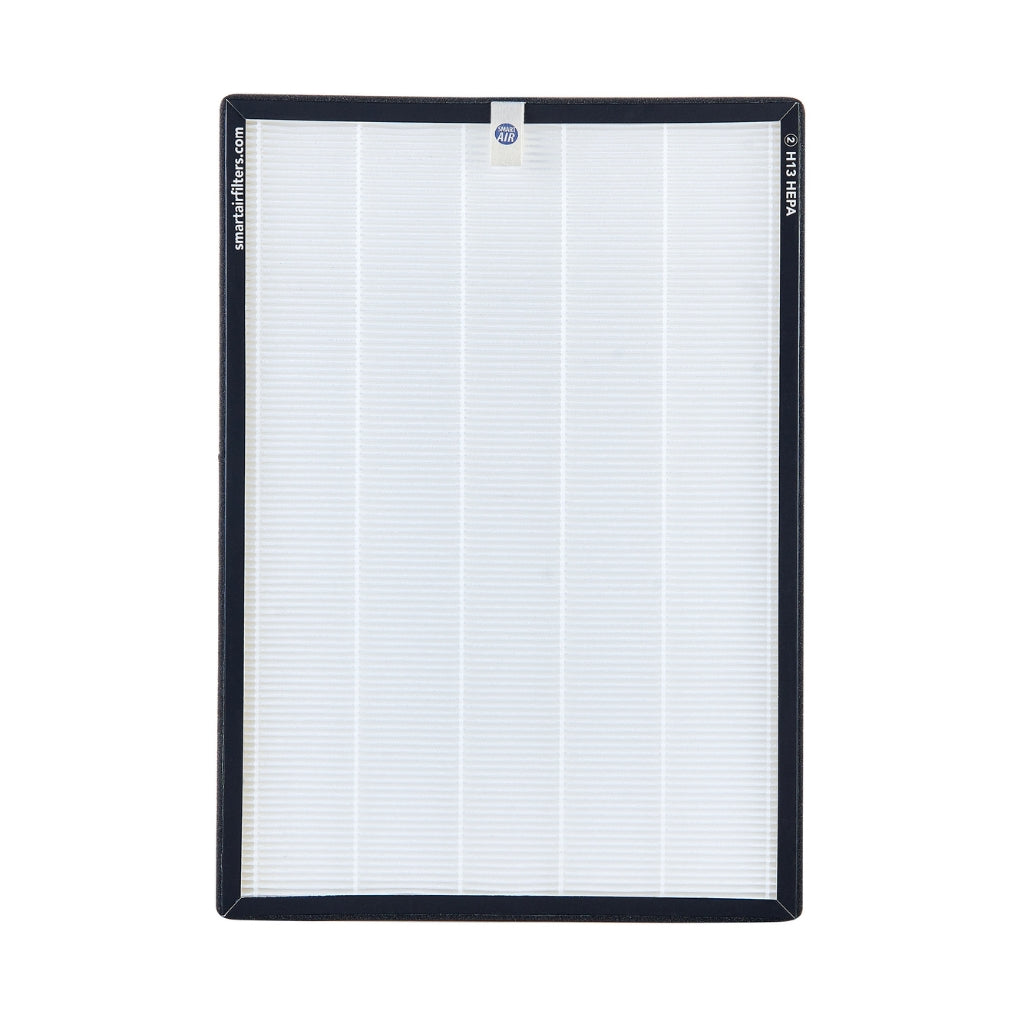
HEPA stands for High Efficiency Particulate Air. The grades (H11, H12, H13) describe how efficiently the filter captures particles at the "most penetrating particle size" (MPPS), which is around 0.3 microns. This is the hardest size to trap, so it's used as the standard test point.
You'll sometimes see lower grades written as E11 and E12 rather than H11 and H12. The E stands for EPA (Efficient Particulate Air), which sits just below the full HEPA threshold in the European classification system. For practical purposes in home air purifiers, E12 and H12 are often used interchangeably. You may also see H13 described as "true HEPA" by some manufacturers to distinguish it from the grades below.
| Grade | Efficiency at MPPS | Common Description |
| H11/E11 | 95% | H11 Grade HEPA/ HEPA type filter |
| H12/E12 | 99.5% | H12 Grade HEPA/ HEPA type filter |
| H13 | 99.97% | Hospital Grade/ True HEPA |
These numbers describe single-pass capture rate at a specific particle size under controlled lab conditions. They don't describe how well the filter performs in your actual room, at your actual air volumes, over time.
One thing worth clearing up: the 0.3 micron MPPS is the hardest particle size to catch, not the lower limit of what these filters handle. For larger particles like dust, pollen, pet dander, and mould spores, which typically range from 1 to 100+ microns, all three grades perform extremely well. And at the other end of the scale, HEPA filters are also highly effective at capturing very small nanoparticles.
This is because at the nano scale, particles don't travel in straight lines. They bounce around erratically due to collisions with air molecules, a phenomenon called Brownian motion, which means they end up hitting and sticking to filter fibres rather than slipping through. Scientists call this capture mechanism diffusion. Smart Air has a good explainer on how diffusion works if you want to go deeper. The short version: 0.3 microns is the weak spot in the middle of the size range, not the bottom of it.
0.3 microns is the hardest particle size to catch, not the smallest. HEPA filters handle both larger particles and tiny nanoparticles extremely well, the middle is where the challenge is.
2. Why throughput matters more than filter grade alone
Here's a way to think about it.
Picture vacuuming a hallway that people keep walking through. If you vacuum once and your machine picks up 99.97% of what's on the floor, that sounds excellent. But if the family keeps coming and going, the hallway gets dirty again regardless. Vacuum twice as often with a machine that picks up 99.5% each pass, and by the end of the day the floor is going to be cleaner, because you've been keeping pace with the mess being made.
Air works the same way. Cooking, pets, opening doors, people moving around. All of these continuously add particles back into the room. A purifier that cleans your room's air once an hour at 99.97% efficiency is doing less useful work than one cleaning it twice an hour at 99.5%. The air doesn't stay clean between passes.
Smart Air tested this directly with the Sqair, measuring airflow with an anemometer. The H12 filter produced 23% higher airflow than H13 in the same unit, which in real terms meant more clean air delivered overall. The weaker filter actually came out ahead because of what it gave back in throughput.

This is what CADR measures. And it's why we focus on it.
3. What is CADR, and how does it connect to this?
CADR stands for Clean Air Delivery Rate. It tells you how much clean air a purifier delivers per hour, in cubic metres. More CADR means faster particle removal.
To figure out how many times per hour your purifier is cleaning your room's air, you use a simple calculation:
ACH (air changes per hour) = CADR / room volume (m³)
Room volume is floor area (m²) multiplied by ceiling height. A typical NZ bedroom at 10m² with 2.4m ceilings comes out to about 24m³.
For most everyday use, aim for at least 3 air changes per hour. For allergy or asthma support, 4 to 5 ACH is a more useful target. For high-pollution events like wildfire smoke, higher is better.
So if you're choosing between a compact H13 unit with 100 m³/h CADR and a well-sized H12 unit with 315 m³/h CADR, the H12 unit is going to do far more work in a real room. The filter grade difference is largely academic if the air isn't moving through the filter enough.
In virtually all situations, a purifier with high CADR and an H12 (or even H11) filter will outperform a weaker H13 unit. Throughput wins!
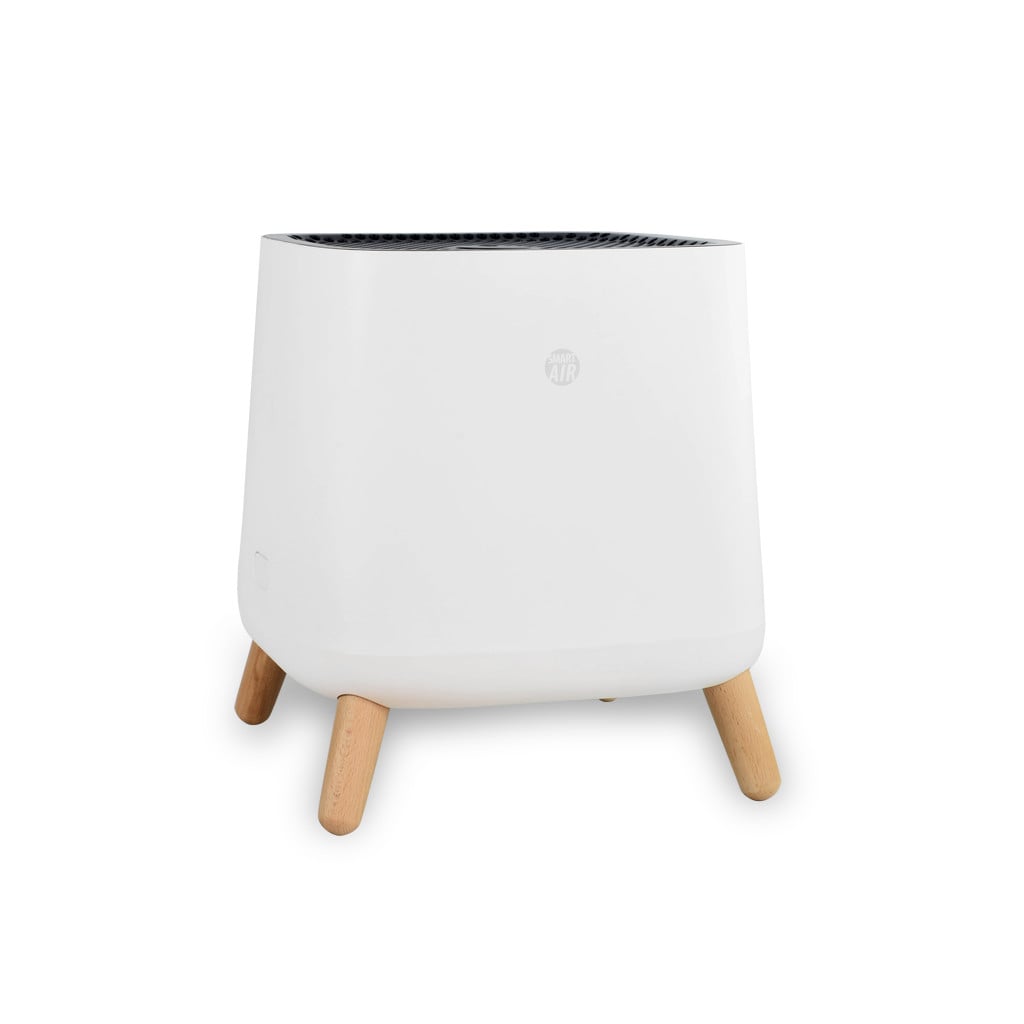
Smart Air Sqair: A strong H12 HEPA purifier for most homes
Key features:
- 315 m³/h CADR on high cleans up to 43m² in 20mins
- Simple 3-speed dial; no app, no Wi-Fi, nothing to configure
- H12 HEPA captures dust, pollen, pet dander, PM2.5, and mould spores very effectively
- Carbon filter included as standard for odour reduction
- Great CADR-to-price ratio, one of the best value options in the range
- No ionisers or ozone-producing technologies

4. When H13 does make a genuine difference

It's worth noting that several of our purifiers, the SA600, Blast Mini Mk II, and Blast Mk II, use H13 filters. At the CADR levels those units operate at, you get both strong throughput and H13 efficiency on every pass, so there is no trade-off to speak of.
But H13 only earns its place when the CADR is there to back it up, and that's worth understanding before you use filter grade as a buying shortcut.
You'll sometimes see "medical grade" used alongside H13 as a selling point. In genuine medical settings like hospital ventilation systems, air often passes through a filter just once before being distributed, so single-pass efficiency is everything and H13 or above makes sense. A home or office purifier works differently. It continuously recirculates the room's air, which means you're getting pass after pass through the filter. That changes the equation considerably.
Where H13 can earn its place in a purifier are when:
You're comparing two purifiers with similar CADR. H13 gives you a real if modest improvement in per-pass capture, with no throughput trade-off.
You're in a higher-risk environment like a clinic with vulnerable people present, and you're pairing H13 with a unit that has a high CADR to match.
You want maximum filtration and aren't giving anything up in airflow to get it.
The short version: H13 is a good thing when CADR is equal. It becomes a liability if it comes at the cost of airflow.
Wrap-up: Does filter grade really matter?
It does, but probably less than you'd think from the marketing. For most homes, the bigger wins come from getting the CADR right for your room size and making sure the purifier can run consistently at a noise level you're comfortable with.
- H11, H12, and H13 all capture dust, pollen, pet dander, and mould spores very effectively
- The step from H12 to H13 is real, but only meaningful if the CADR is there to match
- A slower H13 unit will generally clean your air less well than a faster H12 unit in the same room
- "Hospital grade" and "medical grade" are marketing terms, not regulated certifications
- Air change rate matters more than single-pass efficiency in a recirculating home purifier
HEPA air purifiers for clean, everyday air
These purifiers focus on the fundamentals: H12 and H13 HEPA filtration and strong airflow, without ionisers, ozone, or unnecessary complexity.
Is H13 better than H12?
In terms of single-pass capture efficiency at the hardest particle size, yes. But in a recirculating home purifier, that difference only matters if the CADR is strong enough to keep air moving through the filter regularly. A high-CADR H12 unit will clean a room more effectively than a slow H13 unit.
What's the difference between E12 and H12?
E12 is from the European classification, but the terms are often used interchangeably for home purifiers. If you see E12 on a product, it refers to the same practical filter grade as H12.
What does "hospital grade" or "medical grade" actually mean?
Neither is a regulated certification. They're marketing terms used loosely to describe H13 filters. In real medical settings, filtration requirements go well beyond filter grade alone and involve specific ventilation design that home purifiers don't replicate.
Will an H11 filter catch dust and pollen?
Yes, very effectively. Dust, pollen, and pet dander are much larger than the 0.3 micron test particle used to grade HEPA filters, and all grades capture them well.
What's more important: filter grade or CADR?
For most homes, CADR matters more. It determines how often the air in your room is actually being cleaned. Filter grade is secondary; useful when CADR is equal between two options, but not a substitute for adequate airflow.
Should I get an H13 unit if I have allergies?
Not necessarily. Focus first on whether the unit delivers enough air changes per hour for your room size, and whether it can run quietly enough to leave on overnight. Those factors will generally have more impact on how you feel than the difference between H12 and H13.
Relevant Articles:


Share